
FTTX Solutions by YOPTIC
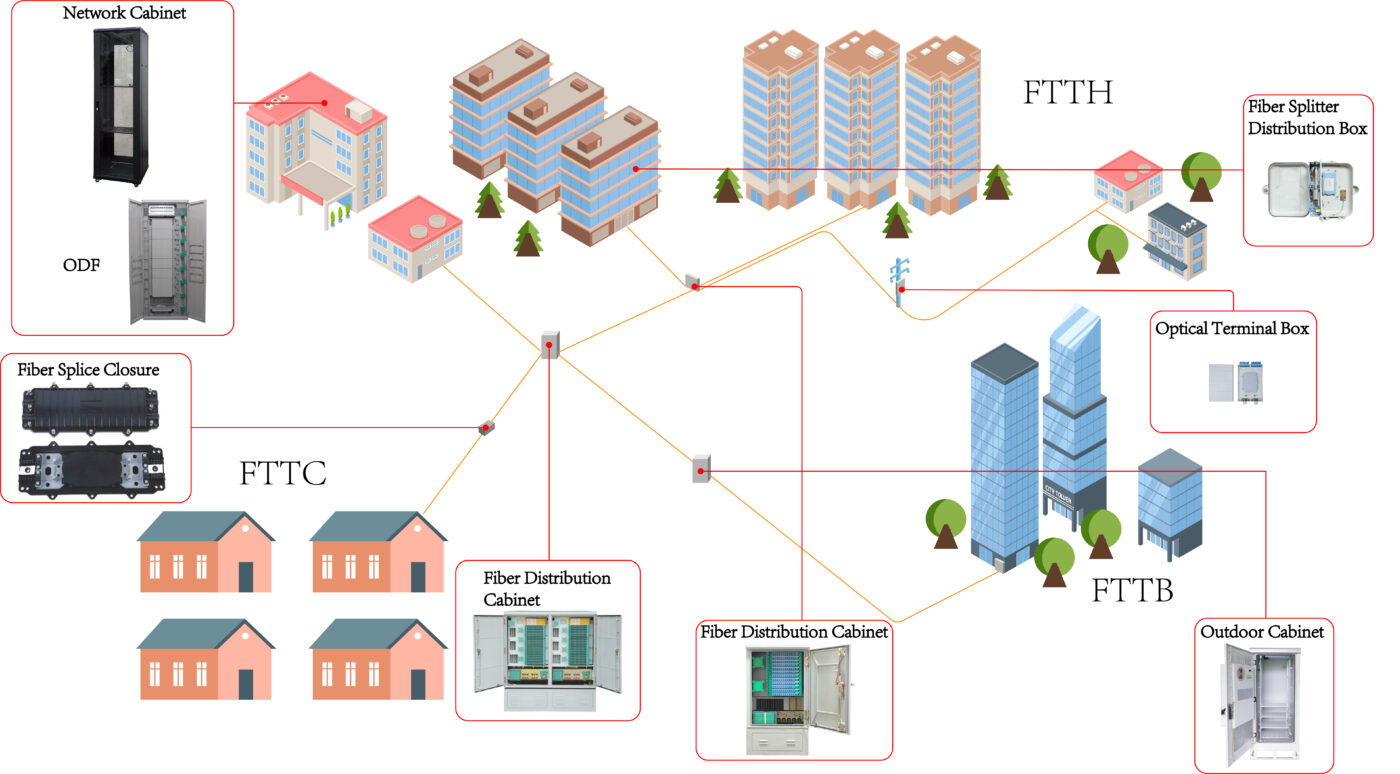
Fiber to the x (FTTX) is a generic term for any broadband network architecture using optical fiber to provide all or part of the local loop used for last mile telecommunications.The telecommunications industry differentiates between several distinct FTTX configurations. The terms in most widespread use today are:
FTTH (fiber-to-the-home): Fiber reaches the boundary of the living space, such as a box on the outside wall of a home. Passive optical networks and point-to-point Ethernet are architectures that are capable of delivering triple-play services over FTTH networks directly from an operator’s central office.
FTTB (fiber-to-the-building, -business, or -basement): Fiber reaches the boundary of the building, such as the basement in a multi-dwelling unit, with the final connection to the individual living space being made via alternative means, similar to the curb or pole technologies
FTTC (fiber-to-the-curb, -closet, or -cabinet): The street cabinet or pole is closer to the user’s premises, typically within 1,000 feet (300 m), within range for high-bandwidth copper technologies such as wired Ethernet or IEEE 1901 power line networking and wireless Wi-Fi technology. FTTC is occasionally ambiguously called FTTP (fiber-to-the-pole), leading to confusion with the distinct fiber-to-the-premises system.
In order to supply comprehensive FTTX solutions and meet the various requirements worldwide, YOPTIC provide a range of various equipment which enable you to make your own choices according to the actual field situation.
FTTX represents a comprehensive term encompassing a category of fiber - optic access technologies. Its complete name is Fiber To The X, signifying "Fiber to the X location".
Types of FTTX:
FTTH: Fiber To The Home
Fiber directly to the home. This is the mainstream for most home broadband services nowadays.
FTTB: Fiber To The Building
Fiber to the building. The network is then distributed to users via cables within the building.
FTTC: Fiber To The Curb
Fiber to the curb / community cabinet. The last section is connected to the user via copper wire.
FTTP: Fiber To The Premises
Fiber to the user end. This is often used interchangeably with FTTH.
The main equipment required for an FTTX system includes the Optical Line Terminal(OLT) installed in the central office, optical splitters for signal distribution, and ONU or ONT at the user side. It also uses optical fiber cables for signal transmission, Optical Distribution Frame(ODF), Fiber Distribution Cabinet(FDC), Fiber Splitter Distribution Box(FDB), Optical Terminal Box(OTB), for fiber connection and management, as well as routers and switches to provide local network access for users.
In FTTX systems, the typical attenuation of single-mode fiber is around 0.32–0.36 dB/km at 1310 nm and 0.19–0.23 dB/km at 1550 nm.
An Fiber Distribution Cabinet(FDC), also known as a fiber distribution cabinet, is a key outdoor device in an FTTX network. It is used to connect, distribute, and schedule optical fiber lines between the backbone network and the user access network. It protects optical fibers and connectors, provides a stable external environment, and facilitates installation, maintenance, and fault location. It plays an important role in connecting the central office to optical splitters and user-side optical cables.
The main industry standards for optical cross-connect cabinets include YD/T 988 and GB/T 39564.1 in China, which specify the structure, environmental performance, protection level, and optical properties of the cabinets. International standards such as ITU-T L.206 and IEC 60529 are also widely used. These standards define requirements such as IP65 protection level, working temperature from -40°C to +60°C, and related optical and electrical indexes to ensure reliability in outdoor FTTX networks.